Iceland 2026: Land Of Fire & Ice
Workshop Information Packet
Contents:
I. General Information
II. To Do Checklist
III. Daily Itinerary
IV. FAQs
Iceland 2026: Land Of Fire & Ice
General Information
Welcome!
Thanks again for joining our Iceland 2026: Land of Fire and Ice Photography Adventure! We know you’re as excited us to begin our adventure! But first, a bit of planning is needed to make sure everything goes smoothly. This document contains important information to help you prepare for our journey. Please take the time to read it carefully.
Workshop Dates: October 6-16, 2026
Workshop Overview
The workshop begins when we meet you upon your arrival at Reykjavík–Keflavík Airport (Airport code: KEF) in Reykjavik, Iceland on October 6, 2026 (or earlier) and ends when we drop you off at the same airport on October 16, 2026, to begin your homeward journey.
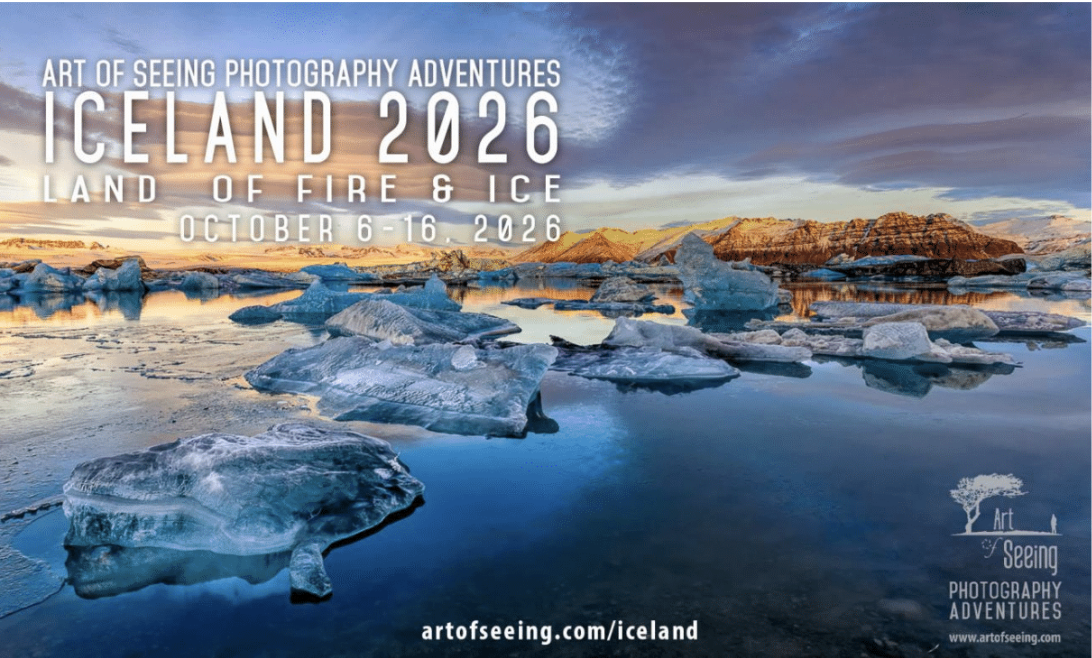
In between we will explore and photograph many of Iceland’s natural attractions including spectacular waterfalls, ice-filled black sand beaches, and hopefully, opportunities to capture the northern lights.
Take a look at the Daily Itinerary in this packet or on the workshop page of our website for more details about the locations we will visit and the things we can expect to see and photograph throughout our journey.
Balance of Fees
The balance of your workshop fees are due as follows:
Payment #2: $3000 due February 8, 2026
Final Payment: Due June 8, 2026. Remainder of all fees - the exact amount of your final payment depends on options selected such as single lodging and extra hotel nights.
You will receive an invoice by email after registration that contains all charges, payments and due dates related to this workshop. Click the link in the invoice to access your Customer Portal where you can make payments, view or download statements, receipts and more at your convenience.
Health/Medical
Immunizations – there are no specific immunization requirements to enter Iceland, but you should consult with your doctor or travel clinic about any recommended vaccinations. The U.S. CDC website also contains general information which may be useful.
Prescription Medications – pack an adequate supply of any prescription medications (and supplements) you take, as they may not be available in Iceland. I also always carry a course of antibiotics when traveling, just in case. You can request a prescription for ‘traveler’s diarrhea’ from your health provider or travel clinic.
Allergies – please let us know about any allergies you have AND the severity of your reactions. It is your responsibility to carry appropriate medications (e.g. Epi Pen) in case of accidental exposure.
Travel Logistics & Documents
International Flights –
Inbound – Book your flights to arrive in Reykjavik (KEF) by 1pm on October 6.
Outbound – Book your departing flight from KEF for after 4:00PM for October 16. Most flights to the US leave in the evening.
Extra hotel nights - if you are arriving in Reykjavik before October 6, just let us know your itinerary specifics and we will book the additional hotel nights for you as needed (~$225/night).
Passport – now is the time to double-check the expiration date of your passport. Your passport must be valid for at least 3 months past the date you will depart Iceland.
Visas/ETA’s
American citizens – the planned implementation of European Travel Information and Authorization System (ETIAS) has been pushed back to late 2026. An official start has yet to be announced. Additional information will be provided in our pre-trip emails as it becomes available.
Other Nationalities– Please check here to determine if a visa or ETA is required
Travel Insurance – a policy which includes coverage for medical evacuation is mandatory for workshop participants. Please forward us a copy of your travel insurance policy (summary page is fine). The primary purpose of this requirement is in case of medical emergency, cost should not be a consideration in getting you quality medical care. Policies that cover medical evacuation as well as other things like trip cancellation, travel delays, lost luggage, theft/loss, etc. are widely available and reasonably priced.
Phone Carrier – look into your phone carrier’s international roaming policies and rates BEFORE leaving home or you may return to an extremely expensive bill. You may want to pre-purchase a data plan from your carrier.
WhatsApp – is a free communications app that is used widely outside of the US. We will be using this for inter group communications. Please download & install WhatsApp and create an account before arriving in Iceland. You may want to also want to have your loved ones at home install this app also.
What to Pack
Weather Note – October is a transitional month in Iceland, characterized by increasing rainfall and the possibility of early snowfall. The weather can be quite variable, so it’s advisable to pack layered, waterproof clothing to stay comfortable during our outdoor photography sessions
Historical averages for our dates in Iceland:
Daytime Highs: 37°F – 46°F
Overnight Lows: 27°F – 36°F
Clothing & Personal Items – as always, layering is the key to staying warm, dry and comfortable as conditions and activity levels change. The following are general recommendations for the essentials and not intended to be a complete packing list.
Base layers (top & bottom) – A good set of merino wool or synthetic base layers will help preserve body heat, especially during times we are standing in one spot for an extended time (e.g. night photography).
Mid Layers – down (puffer) jackets/vests, wool sweaters, soft shell or fleece are good options for your mid-layers. Lined pants made for cold weather or heavyweight corduroy on top of your base layer are the best option to keep your legs warm. Jeans are NOT a good choice.
Outer Layers – truly waterproof outer layers (tops AND bottoms) are essential.
Warm socks – merino wool again or synthetic. A very thin pair next to the skin with a thicker second pair on top work best.
Waterproof boots – We will be walking through muddy, marshy terrain at times. A pair of over-the-calf muck boots will work well. Alternatively, rain boot covers are a lighter, more affordable option that pack easily. Here’s a link: Rain Boot Covers on Amazon.
Gloves - a pair of thin gloves that will let you work camera controls without removing them should be enough but those whose hands get cold easily may want a pair of mittens as well. There are also several options photography-specific gloves/mittens also. Ask our friends Google and Amazon and do your research
Heated clothing (optional) –there are many options now for heated jackets, vests, and gloves powered by rechargeable batteries. Most work quite well but may not last an entire day and you must recharge batteries nightly. Make sure to pack the batteries in your carry-on luggage, as they are not allowed in checked baggage.
Warm hat or beanie
Balaclava, scarf or buff – to protect your face and neck
Polarized Sunglasses
Hand & Toe warmers – optional but handy especially if your extremities get cold easily.
Photo Gear – it’s tempting to bring everything you own, but that usually works against you. If you decide to bring the kitchen sink, we strongly recommend bringing a smaller camera bag/backpack that you are comfortable carrying all day as well. We’re happy to give more specific brand/model recommendations for specific items. Just ask.
Camera Body – most modern dSLR or Mirrorless camera bodies will work well. Bring a paper or electronic copy of your camera’s operating manual. Keep in mind your smartphone is also a great camera. Use it as a serious tool and you’ll get serious results.
Lenses:
Wide-angle(s) (24mm or less, ~15mm ideal) will likely be your workhorse for this trip as we will be shooting a lot of landscapes and night photography
A ‘walkaround zoom’ like a 24-70mm or 24-105mm is another must-have for this trip
A medium telephoto like a 70-200mm zoom is optional but useful for isolating landscape details and creating compression.
Drones- You can bring and fly a drone in Iceland but there are regulations including a 120-meter altitude limit and maintaining visual contact. You are responsible for knowing the rules and flying competently and responsibly. There are a few areas where we cannot fly but a lot of other great options!
Filters – a polarizer, neutral density (ND) and graduated neutral density (GND) filter(s) can be nice to have with varying lighting situations.
Extra Batteries and Memory cards – you will be shooting a lot, maybe more than you ever have. Bring PLENTY of memory cards and batteries. You should NOT erase/overwrite any memory cards until you get home, even if you have downloaded the images to your laptop or hard drive.
Tripod – sturdy, but light with a ballhead is ideal. Your tripod should be tall enough WITHOUT the center column extended that you don’t have to bend over uncomfortably. Be advised high winds are common – leave the ultralight travel tripod at home.
Small Camera bag/daypack – you don’t always need all your gear. A small bag for personal items and a few photo essentials is very handy and a back-saver.
Headlamp – MUCH better than a flashlight because it leaves both hands free. Make sure yours has a red-light option for night photography
Remote release (optional)
Cleaning Kit – nothing fancy, a lens cloth, cleaning fluid and a small brush/toothbrush are all you need
Accessories – make sure to pack critical accessories like your camera battery charger, memory card reader, data cables and tripod quick-release plates!
Other Gear
Laptop or tablet –highly recommended. Your photography will improve if you review your images daily. Doing preliminary selects and ratings also makes the mountain of images more manageable when you get home. We will also have several sessions on post processing and image management in Adobe Lightroom.
Portable hard drive - ideal for image storage/backup. If you are purchasing one, look for a solid-state (SSD) type that is “bus powered” – a drive that gets its power from the computer and does not require a separate power cord (most SSD’s are bus powered). 1TB capacity minimum, 2TB is better.
Power adapters – Iceland runs on 230-volt electricity with Type C or F outlets.
A ‘universal’ adapter like one of these will also work
A small power strip is also handy for charging multiple devices simultaneously but make sure it is specifically designed for travel or rated for 230+ volts. Here are some options
Voltage converters are not needed for most devices - phones/tablets, laptops, camera battery chargers and most other electronics have built in voltage transformers and work just fine with a simple adapter.
Check higher power devices like hair dryers and shavers to make sure they are compatible with 230-volt power. Here is a link to a good article on travel adapters if you need more info.
Chargers and cables for your mobile phone and other electronics
Power bank – extremely handy when traveling. You can even use it to charge a camera battery in a pinch (USB battery charger required)
Phone Leash - optional
MISC
Gratuities – we will have a guide on 1 or 2 occasions. A tip in the $20-$30 range (per person) is customary
Tipping at hotels and restaurants is not expected, but small gratuities are appreciated.
Credit/debit cards are accepted almost everywhere. You can easily get by without local currency.
If there’s anything we’ve missed or you have questions, please contact us via email, text/WhatsApp or phone.
We look forward to meeting you in Iceland!
Ken Lee
+1 949-282-9660 mobile/WhatsApp
ken@artofseeing.com
Leighton Lum
+1 808-398-7689 mobile/WhatsApp
leighton@artofseeing.com
Iceland 2026
To Do Checklist
___ Book Inbound/Outbound flights and forward a copy of your flight itinerary to us.
___ Let us know if you need any extra hotel nights
___ Purchase Travel Insurance and forward a copy of your policy
___ Notify Banks & Credit Cards of your travel plans
___ Check mobile phone carrier’s international roaming policies and plans
___ Make personal packing checklist (click here for a downloadable Photo Trip Packing List template you can customize to your own needs)
Daily Itinerary
| Day | Date | Itinerary | Overnight |
|---|---|---|---|
| 1 | 6-Oct | Rekjavik– Welcome to Iceland! We will be waiting at the KEF airport when you arrive to transfer you to our accommodations in Reykjavik. Relax and rest after your long journey or explore the city until 4pm when we gather for our Workshop Overview meeting followed by a welcome dinner at a local restaurant. | Reykjavik hotel |
| 2 | 7-Oct | Rekjavik – Snaefelness Peninsula – We’ll begin the picturesque drive to the Snaefelness Peninsula early, stopping for breakfast along the way.
We’ll break up the drive with several photo sessions to capture beautiful seascapes and other attractions like the famous Black Church at Budir. In the afternoon, we’ll get settled at our new hotel before heading out for our sunset session to photograph Mount Kirkjufell, a stunning mountain fronted by several waterfalls. Afterward, we return to our hotel for dinner. Note 1: we will be on ‘Aurora alert’ throughout our time in Iceland, meaning a Northern Lights photo session is always a possible addition to each day’s itinerary if conditions look promising. Note 2: Ken and Leighton will host several sessions covering composition, image management, workflow and editing. We prefer to ‘play it by ear’ as far as scheduling these sessions. |
Snaefelnes Hotel |
| 3 | 8-Oct | Snaefelness Peninsula – Ísafjörður - We begin our day with a sunrise photoshoot of Kirkjufell mountain before returning to our hotel for breakfast and checkout. Today we travel to the West Fjords of Iceland, an area not on most tourist itineraries, yet contains beautiful landscapes and seascapes There is a ferry crossing along the way and we will make multiple photo stops including at Dynjandi Falls, one of the most impressive waterfalls in Iceland. | Ísafjörður Hotel |
| 4 | 9-Oct | Ísafjörður – We rise early again for a sunrise photo session near our hotel before returning for breakfast. We’ll explore the West Fjords region for rest of the day. Our photo stops will be dictated by the landscapes and light | Ísafjörður Hotel |
| 5 | 10-Oct | Ísafjörður - Vatnsnes Peninsula –Today we make our way down the West Fjords, stopping at various locations along the way for photographs (4-5hr drive). When we reach our destination in scenic Laugarbakki village, we will check in at our hotel and get settled before heading out to the famous sea stacks of Hvítserkur for our sunset photoshoot. | West Iceland Hotel |
| 6 | 11-Oct | Vatnsnes Peninsula – Golden Circle – Early start, a quick sunrise shoot near our hotel before returning to our hotel for breakfast. Afterwards, we check out and start the drive to the Golden Circle, a superbly scenic (and popular) area with attractions including Pingvellier national park, Gullfoss waterfall, Hraunfossar waterfall and Geysir geothermal area. We’ll plan our stops based on weather and crowd conditions at the time. Later, we’ll check in at our new hotel before heading to Bruarfoss waterfall for sunset. | Golden Circle Hotel |
| 7 | 12-Oct | Golden Circle – Vik – Wake up early to capture sunrise at Gullfoss, Iceland’s most famous waterfall and one of its largest. After breakfast we make our way down the South Coast. Along the way we may stop at several scenic spots such as Seljalandsfoss, Skogafoss, Gljufrabui depending on weather conditions or possibly do a short hike to the Solheimasandur plane wreck. Our plan for sunset is to photograph Reynisfjara Beach or Kirkjufjara, both black sand beaches in Dyrhólaey Nature Reserve. | Vik Hotel |
| 8 | 13-Oct | Vik- Hofn – Sunrise finds us photographing the scenic seafront village of Vik and its beautiful natural surroundings. After breakfast at our hotel, we get back on the road down Iceland’s breathtaking South Coast, towards the famous Diamond Beach (aka Ice Beach) where lare numbers of icebergs calved from Jokulsarlon glacier come to rest on its black sands. We may also make stops at Fjaorargljufur canyon or Skaftafell glacier along the way. Later, we’ll check in and take a break till our sunset shoot at Diamond Beach or Glacier lagoon. | Hofn Hotel |
| 9 | 14-Oct | Hofn – Diamond Beach is our sunrise destination where we hope to create dramatic compositions of early morning rays lighting icebergs on this black sand beach. Breakfast is at our hotel as usual. No traveling on our agenda, so enjoy a relaxing day, maybe work on some post processing before we head out for our sunset shoot. The mighty Vestrahorn mountains are the focus of our evening photo session! A can’t miss location! | Hofn Hotel |
| 10 | 15-Oct | Hofn – Vik – We have one more chance to photograph stunning Diamond Beach or Glacier lagoon at sunrise before packing up and making our way back towards Vik. We will stop at any spots we missed on our way up. Sunset will be around the Vik area. | Vik Hotel |
| 11 | 16-Oct | Vik- Keflavík – Our final sunrise shoot! Or, if you’ve seen enough sunrises, sleep in and enjoy a leisurely morning. After breakfast in Vik will make our way back to Reykjavik airport where we will catch our flights home. End of Service. | - |
Frequently Asked Questions
Q: What are the physical fitness requirements?
A: This trip is rated Easy-Medium. Most of our photo locations are easy to reach for people of average fitness. There are several optional hikes that may require a moderate hike of up to 1.5 miles (one-way). Some locations like waterfalls and beaches may have wet/slippery unpaved surfaces. You must be able to carry your own gear when we are not in our vehicle.
Q: How should I book my international flights?
A: Book your inbound flight to arrive at Keflavik International Airport (airport code: KEF) in Reykjavik, Iceland before 1pm on October 6, 2026.
Book your homeward flight to depart KEF after 6pm on October 16, 2026.
Additional information to help plan your travels will be provided to registered participants.
Q: What if I want to arrive early or stay after the workshop dates?
A: No problem, let us know your arrival/departure details and we will book the additional hotel nights on your behalf (additional cost).
Q: Where will we stay?
A: We will stay in small hotels or B&B’s in each of our locations. Nothing fancy, but clean and comfortable with modern amenities like wi-fi.
Q: Is there an extra fee for a private room?
A: Yes, prices are based on double occupancy. Single lodging is available at extra cost (+$1400).
If you don’t have a travel partner, we will pair you with a same-gender roommate. If a roommate is unavailable, you will receive a single room but be charged the single lodging rate.
Q: Are meals included?
A: Meals are NOT included. Some of our hotels provide a free breakfast but all other meals are at your expense.
Q: Can my non-photographer friend/partner attend?
A: Absolutely, travel partners who may not share your passion for photography are very welcome. Just make sure they can handle being part of a group that wants to do nothing but eat, sleep and talk about photography. Unfortunately, due to limited space, we cannot offer a discount for non-photographer partners.
Q: What is the weather like in Iceland?
A: ‘Average’ daytime and overnight temps are historically in the mid to high 30’s Fahrenheit. However, weather in Iceland is highly variable and can change suddenly. Rain and strong winds are highly like during our trip and snow/hale is also possible.
Additional guidance about appropriate clothing and other items to pack will be provided to registered participants
Q: Can I bring a drone?
A: Yes, you can bring and fly a drone in Iceland but three are regulations including a 120-meter altitude limit and maintaining visual contact. You are responsible for knowing the rules and flying competently and responsibly. There are a few areas where we cannot fly but a lot of other great options!
Q: Will we see active volcanoes and lava?
A: Maybe - Iceland is famous for its active volcanos; we will keep an eye on the activity as we get closer to the trip, and we can plan accordingly if an eruption is happening. Fingers crossed!